|
Why then? |
| Simply to defend their country and
their families. Deposition of the godly Tenno - unthinkable! To see
mothers and sisters raped by gruel Americans (Japanese
propaganda) even more so. |
| To understand the motivation that led
to a warfare unheard of, one has to take the military situation into
account. By mid 1944 it was desparate. |
| In 1942 Japan had held a vast
territory. China, Indochina, Burma, and large parts of the pacific ocean.
The next goal being Australia. Then came the battle of
Midway. Japan not only lost four aircraft carriers, but with them hundreds
of well trained pilots. In 1943 the battles in the Solomon islands chain were
costly again. More veteran pilots were lost, replacements had to be taken
prematurely from training. They fell even quicker (not at least
due to the flimsy construction of their aircraft). In the US there was no
lack of well trained pilots, superior aircraft and -carriers left the factories in a
steadily growing stream. Japan lost island after island. When in spring 1944 also
the Marianas fell victory for Japan was out of question, especially so
because an all out attempt had ended in great loss of materiel and personnel.
Hundreds of pilots (including the last carrier capable
ones) were lost in one day ("the great Marianas turkey shoot"). Afterwards there were only very few capable pilots left. |
| Aircraft (and pilots) are vital in an
environment where small reefs and islands are separated by hundres
of miles of sheer water. The posession of an island with an airfield on it
allows control over sea and land around it (measured by aircraft range).
Therefore the Allied warfare in central pacific relied almost entirely on aircraft
carriers, hitting at will whatever Japanese stronghold could be used as
staging point for the next operation. On the other side Japan having had
lost most of its carriers was glued to each of its islands, not
knowing which one was the next target for US strike forces. |
| By 1944 also the Army branch of the Jap.
armed forces (having fought in New Guinea and adjacent inslands) had be driven back to the Philippines. Also with great losses. |
| In Western eyes ordering a meagerly
trained pilot to fight a 10.1 supremacy in an elderly aircraft would be
called murder. But there was no choice. As surrender was out of question
they had to fight to get an acceptable peace treaty at least. When they left the airfield they were sure only a few would come back
(if any). They fell like flies. |
| To defend the Philippines
against the "big blue blanket" (US carrier based aircraft)
the Japanese Navy
had a mere 27 aircraft (30 to other sources, but this
doesn't make it much better). |
| That fighting could mean death was
deeply imposed in every Japanese soldier. If it led to victory death was
justified. This was the old Samurai tradition every soldier lived after.
Furthermore "Bushido" had influenced Japanese thinking so much
that surrender would be loss of honour (worth more than one's life), but
also a disgrace with ever lasting shame on
the family. Last not least many Japanese believed in Buddhism, where death
was simply a transition from one life into an other (the warrior being
reborn in "Yasukuni", some sort of "Walhall", where one met the heroes of
former times and savoured the very best). |
| In the result: When you were killed
anyway (without having achieved anything) then it made some sense indeed
to go for the carriers (where all these threat came of) and aim with the
own aircraft to the last. In Samurai tradition this was a most honorable way to die (and gain victory). |
|
Due to their unprotected wooden decks US aircraft carriers were very
vulnerable. Especially so because in the hangar deck one level below there
were not only aircraft fully gassed up
but also all sorts of ammunition to be loaded for the next mission. If
they were heated by fire they would blow up. |
|
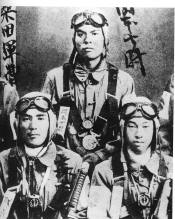
In the result the first "Kamikaze"-mission was flown Oct. 25th 1944.
Many were to follow. |